Updated:
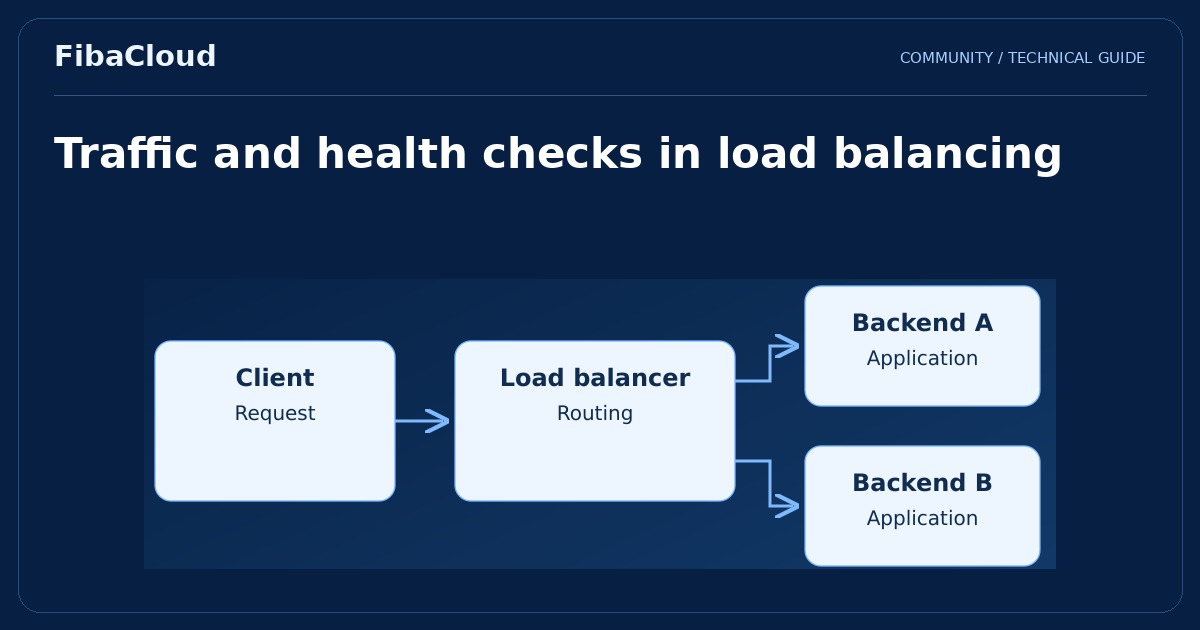
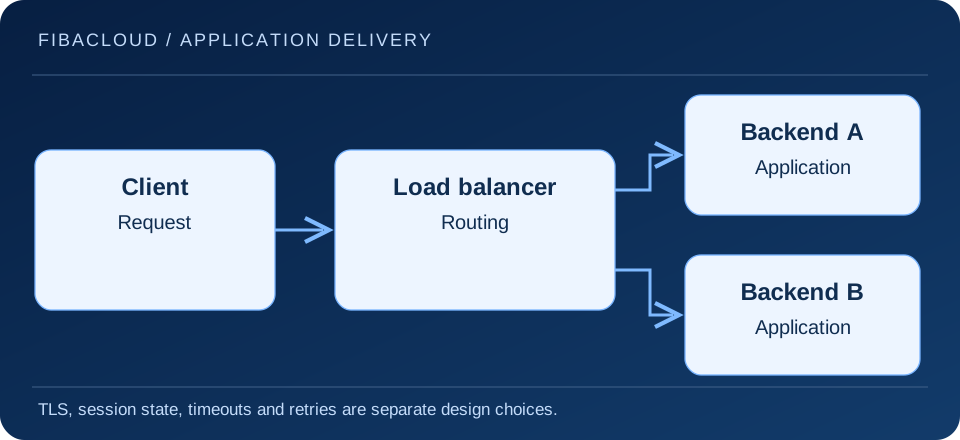
A load balancer routes client traffic to eligible backend servers. It can distribute capacity and, in a suitable design, stop sending traffic to a failed server. It does not automatically make the whole application highly available: databases, session state and other shared dependencies still need their own design.
Enlarge illustration →
Choose between L4 and L7 by requirement
Layer 4 balancing routes connections or flows using transport information such as TCP or UDP. Layer 7 balancing understands an application protocol such as HTTP and may route by hostname or URL path. These are different tools rather than universally better and worse versions of the same feature. The application protocol and required control determine the fit.
Check supported protocols, algorithms and connection limits in the selected product’s documentation. Round-robin and least-connections approaches can behave differently under different workloads. Equal request counts do not necessarily mean equal processing load when request cost and duration vary significantly.
Make health checks meaningful
An open port does not prove that the application can complete a user transaction. A readiness endpoint should represent the conditions needed to accept traffic. At the same time, performing an expensive database operation on every probe can create extra load or a shared failure dependency. Balance the check’s scope with the application’s actual behavior.
Review failure and recovery thresholds, probe frequency and timeouts together. Overly sensitive checks can repeatedly remove and reintroduce a server; overly permissive checks can keep sending traffic to a broken backend. During maintenance, test what happens to existing connections and any supported connection-draining behavior.
Understand TLS and forwarded identity
TLS may terminate at the load balancer, pass through it or be re-established toward the backend, depending on the product and protocol. Encryption between the client and the balancer does not prove that the backend connection is encrypted. Assign ownership for certificates, private keys and upstream certificate validation where applicable.
If the application obtains a client address from a forwarded header, configure which proxies it trusts. Accepting arbitrary client-supplied Forwarded or similar headers can undermine address-based decisions. Forwarded network information is not, by itself, proof of a user’s authenticated identity.
Decide where application state lives
When a session exists only in one server’s memory, a request routed elsewhere may lose the user’s state. Sticky sessions can help some transitions, but they do not preserve that state when the selected server fails. Evaluate a shared session store or an appropriately stateless design against the application’s requirements.
Uploaded files, background jobs and database connections also belong in this analysis. Duplicating the web tier does not duplicate every dependency. Identify shared services, their capacity limits and the behavior expected when one of them becomes slow or unavailable.
Coordinate timeouts and retries
Client, load balancer and application timeouts should form a coherent policy. Unbounded retries can amplify an overload incident. Retrying a payment or order-creation request may cause duplicate processing unless the application supports safe repetition. A retry policy needs to account for request semantics, not merely whether a network error occurred.
Before rollout, test a lost backend, a slow response, no eligible backends and connection handling during maintenance. Monitor response time, error rate and backend distribution. A useful acceptance test proves that representative user actions work within the chosen limits; seeing traffic reach two servers is not enough.
Frequently asked questions
- Will a load balancer always make an application faster?
-
No. A database, application-code or shared-storage bottleneck may remain unchanged when more web servers are added.
- Does adding a load balancer prevent outages?
-
Not by itself. Failure handling for the balancer, application and dependencies must be designed together.
Your next step
Match the load balancer service to your application’s protocol and scope. Use the firewall guide to plan the corresponding access boundaries.