Updated:
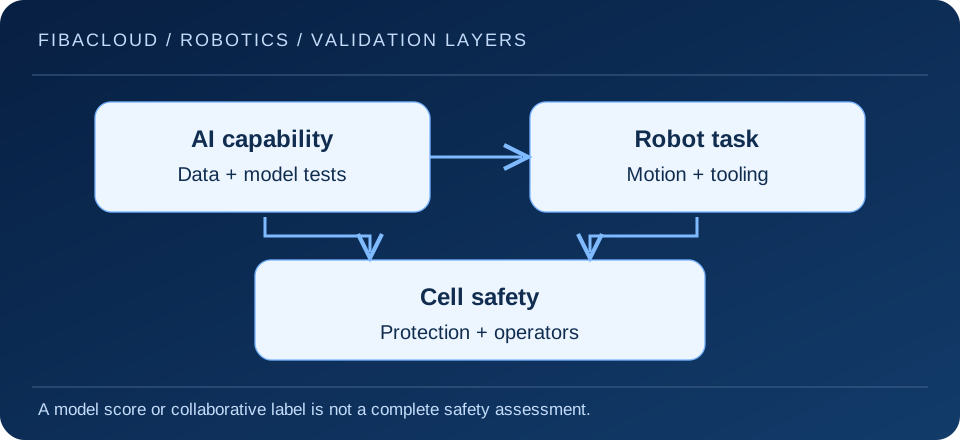
AI can add perception, classification or adaptation to a manufacturing robot, but a model is only one part of the cell. Sensors, tooling, motion control, workers and the production process determine what the system can do safely and consistently. Start with a bounded task and validate the complete installation rather than assuming that AI makes a robot autonomous or safe.
Enlarge illustration →
Define the task before selecting the model
Inspection, part picking and process monitoring have different data and timing requirements. Record the parts, lighting, tolerances and operating conditions the system must handle. Identify the cases where it should reject a result or request human review.
Not every robot needs natural-language processing or machine learning. A conventional control approach may be simpler to validate for a stable task. Use AI where the added capability justifies its training, monitoring and maintenance requirements.
Evaluate the model under representative conditions
Training accuracy is not an acceptance test for a production line. Keep evaluation data separate, include variation in parts and lighting, and measure the errors that matter to the process. Missing a defect can have a different consequence from rejecting a good part.
When the product, camera or environment changes, earlier performance may no longer apply. Track model and dataset versions so an observed result can be connected to the actual configuration used on the line.
Keep safety controls distinct from prediction
| Layer | Question to resolve |
|---|---|
| AI perception | How is uncertainty or an unfamiliar input handled? |
| Robot control | How are motion limits and timing enforced? |
| Cell safety | What independent protection and stopping functions are required? |
| Human operation | Who can enter, restart or override the process? |
Assess the complete cell, including tooling, operating conditions, human access and the consequences of a failed control. Document the protective measures and acceptance criteria required by qualified safety engineering and the applicable installation requirements.
Place cloud services outside unsupported control assumptions
Cloud resources may help manage datasets, train models, compare versions or analyse fleet history. Whether inference runs locally or remotely depends on the task’s timing, connectivity and design. Do not assume a public internet connection is an acceptable dependency for a safety-critical action.
Secure remote maintenance and deployment paths. Restrict who can change a model, robot programme or configuration, and keep an auditable release record. Plan a validated return to the previous version when a change fails acceptance checks.
Measure the whole production result
Compare throughput, defect escapes, false rejects, downtime and maintenance effort against a documented baseline. Include integration, tooling, training, review and support in the cost. A better model score does not automatically mean lower production cost.
Introduce changes in a controlled pilot before wider use. Train operators to recognise failures and report unexpected behaviour. The goal is a repeatable process with clear responsibility, not an unqualified promise of perfect quality or continuous operation.
Frequently asked questions
- Are collaborative robots safe without a cell-level assessment?
-
No. Safety depends on the full application, tooling, operating conditions and required protective measures. The robot label alone is insufficient.
- Can cloud model training replace testing on the actual production process?
-
No. Training supports development. Acceptance must consider representative parts, sensors, timing, operators and the installation’s safety requirements.
Your next step
Discuss dataset storage and compute needs with FibaCloud, while keeping production acceptance and robot safety within the appropriate engineering process.