Updated:
A dedicated CPU cloud server offers a reserved allocation of processor capacity within its service model. The exact meaning varies between providers. Evaluate how vCPUs relate to physical processing resources, what usage limits apply and which other resources remain shared before using the label to predict application performance.
Enlarge illustration →
Read the allocation definition
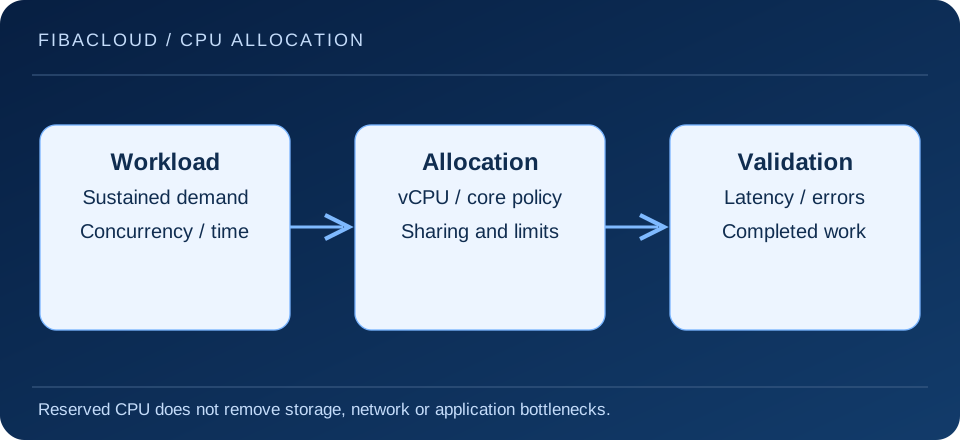
A vCPU is not automatically a complete physical processor core. It may correspond to a hardware thread or a different scheduling arrangement. Processor architecture and generation also affect the work completed by the same advertised vCPU count. Matching the numbers in two price tables is therefore only the beginning of a comparison.
Reserved processor capacity does not mean that memory paths, storage, network connectivity and the entire physical host belong to one customer. This separates dedicated CPU plans from bare metal allocation. If direct hardware control is required, describe that as a separate requirement rather than inferring it from the CPU label.
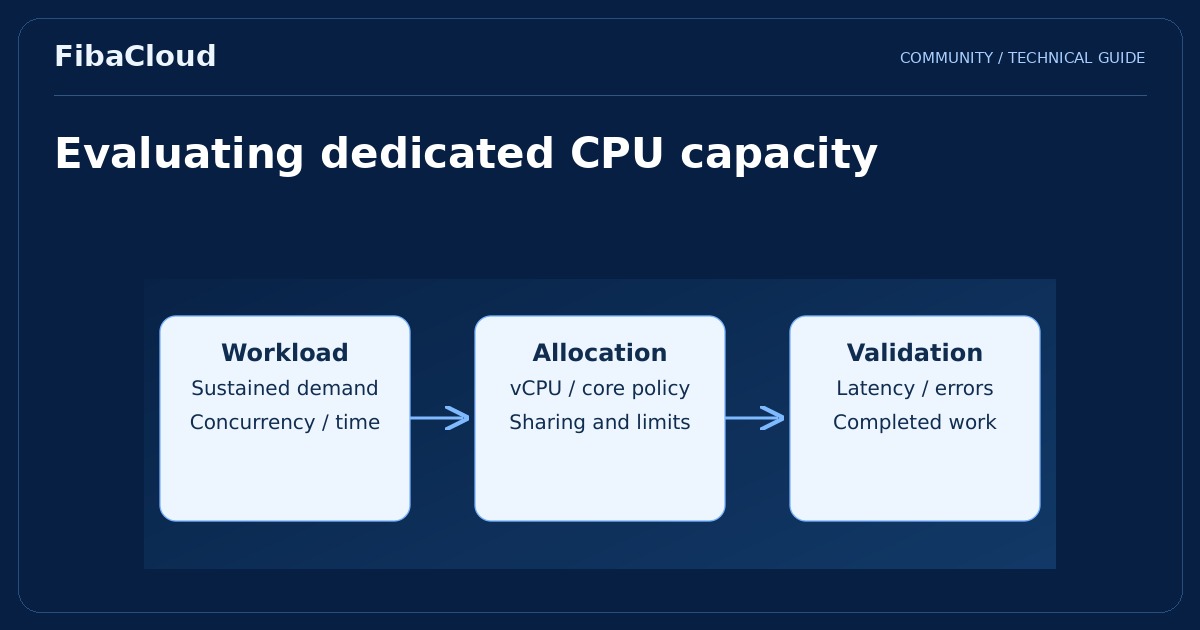
Identify workloads that need sustained processing
Data processing, frequent builds, busy application services and some database operations can consume CPU for extended periods. Predictable processor allocation may matter for these workloads. Applications spending most of their time waiting on disk, a remote API or lock contention may see little improvement from changing CPU allocation alone.
For a growing job queue, measure queue depth, concurrent workers and completion time per job first. If processing demand is the constraint, test reserved capacity. If database waits dominate, investigating queries, connection pools or storage may be more effective. A useful upgrade starts with a bottleneck hypothesis that can be checked.
Compare shared and dedicated plans fairly
Shared CPU can suit development systems and applications with low average usage or brief bursts. Dedicated CPU is not a mandatory upgrade for every project. Compare memory, storage, transfer, licensing and backup conditions for the same operational need. Understand which capacity limits sit behind each price.
Use the same application release, dataset and client workload in a comparison. Cache warm-up, remote services and the time of the test can change results. Repeat representative tests and record latency, completed work and errors together. A better synthetic CPU score is insufficient if the user-facing application remains slow or unreliable.
Measure the whole execution path
- Track processing duration and latency distribution during busy periods.
- Observe CPU utilization, runnable work and guest scheduling indicators where available.
- Check memory pressure, storage latency, network transfer and application failures.
- Compare total cost per completed task and the trend in capacity demand.
Metric interpretation depends on the operating system and hypervisor. A missing metric is not proof that no contention exists. Correlate guest observations with the platform measurements that are available. If support is needed, provide timestamps and reproducible symptoms instead of relying only on a utilization screenshot.
Make the change with a recovery path
Confirm whether a plan change requires a restart, migration or address change. Prepare a current backup and a rollback decision before the maintenance window. Afterwards, check service health, job queues and user transactions. If the expected improvement does not appear, revisit the bottleneck assumption instead of repeatedly buying larger plans.
Keep an observation period long enough to include the workload’s important cycle, such as a scheduled report or daily import. Compare equivalent periods and note any unrelated software change. This makes the capacity decision useful for future planning as well as the immediate migration.
Frequently asked questions
- Does dedicated CPU eliminate latency?
-
No. Storage, networking, application behavior and external dependencies still contribute. Evaluate service limits and representative workload results together.
- How many vCPUs should I choose?
-
Concurrency, processing duration and memory demand matter. Start with a representative workload test; visitor count alone cannot determine an exact size.
Your next step
Compare shared CPU and bare metal allocation. For a FibaCloud plan, confirm the processor definition, limits and resizing process in the actual service scope.