Updated:
Centralized log analysis helps teams investigating a VMware Log Insight environment bring system and application records into a common search and investigation workflow. Records from different components can be compared by time and context. Collection alone does not prove that an event is understood or that every relevant source is covered.
Enlarge illustration →
Why centralize logs?
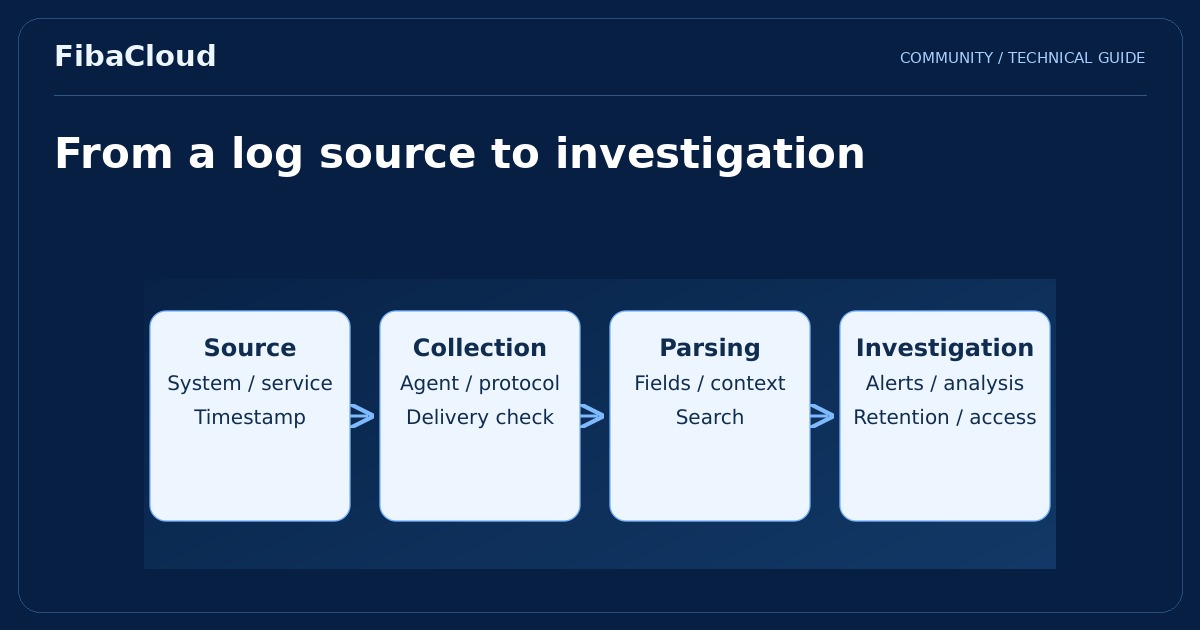
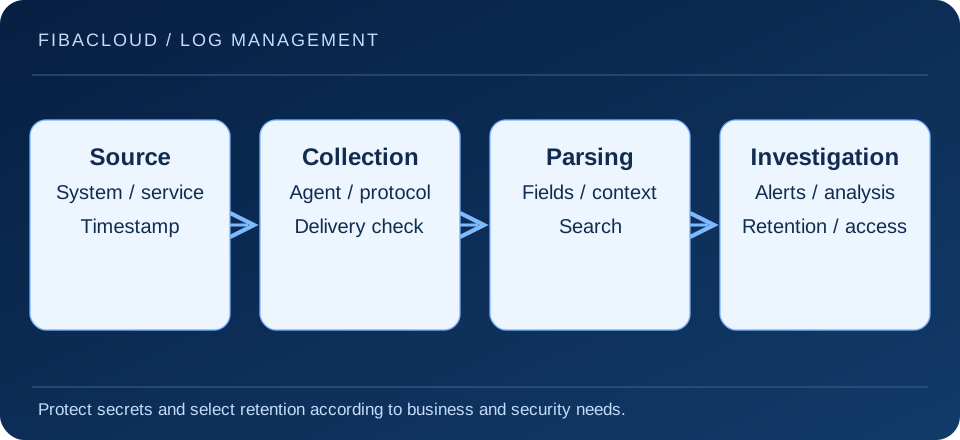
An application failure can leave different records in a web server, identity service and database. Reviewing them within a common time window helps reconstruct the event. For short-lived machines, keeping logs only on a local disk can also remove evidence before an investigation begins.
Centralization cannot create an event the application never recorded. Incorrect clocks and missing context can still produce misleading results. Knowing which sources are covered, which time conventions they use and where losses occur matters more than the total amount of stored data.
Match release and collection scope
Confirm the product name, installed release and deployment model in the management interface before choosing documentation. The linked Aria Operations for Logs 8.18 and VCF 9.1 documents describe those releases; they are not interchangeable instructions for every older environment. Check supported agents, protocols, content packs and integrations against the documentation and license terms for your actual installation.
A connected source does not prove that every event is received. Filters, buffering limits, network interruption and parsing failures can affect coverage. Generate a controlled test event and verify that it appears centrally with the expected fields. Do not use passwords or personal information in that test.
Make fields and timestamps useful
Timestamps, source identifiers, severity and request IDs make investigation more focused. Shared context can help connect one request across services. Similar words in raw text do not by themselves establish that two records belong to the same transaction.
Check clock synchronization and time-zone conversion. Events displayed in the same second may have occurred in a different order. When parsing rules change, review whether historical and new records remain comparable. A field that silently changes name can alter search results and alert behavior.
Design actionable alerts
- Define the business or security condition an alert is intended to reveal.
- Distinguish a single event from a repeated pattern.
- Account for expected records during maintenance and deployments.
- Assign an owner, investigation steps and escalation conditions.
- Use false positives and missed events to improve the rule.
A central logging platform is not, by itself, a complete security operation or an automatic incident-resolution process. Account activity, application behavior and infrastructure metrics may need joint investigation. Actions such as revoking access or isolating a system require an authorized process and a record of the decision.
Balance retention, capacity and privacy
Log volume changes with software releases, failure frequency and verbosity. Select retention according to business, legal and security needs instead of assuming indefinite storage is desirable. Archives, backups and actively searchable data can have different access and cost characteristics.
Reduce passwords, access tokens and unnecessary personal information at the source. Apply roles and access restrictions to the central store. Exporting records during an investigation is also a form of data sharing: limit the content, recipients and retention appropriately.
Include collection health in regular operations. Expired certificates, changed permissions or a newly deployed service can create a gap without producing the application incident the team expects to see. Periodic source checks help keep investigation capability aligned with the current environment.
Frequently asked questions
- Does Log Insight automatically solve every application error?
-
No. It supports investigation of collected records. Root-cause analysis and a suitable authorized operating process are still required.
- Is longer retention always better?
-
Retention depends on need. Consider cost, sensitive information, access exposure and legal requirements together.
Your next step
Compare logs with vROPS metric analysis. In the cloud security plan, assign owners for log access, retention and incident investigation.