Updated:
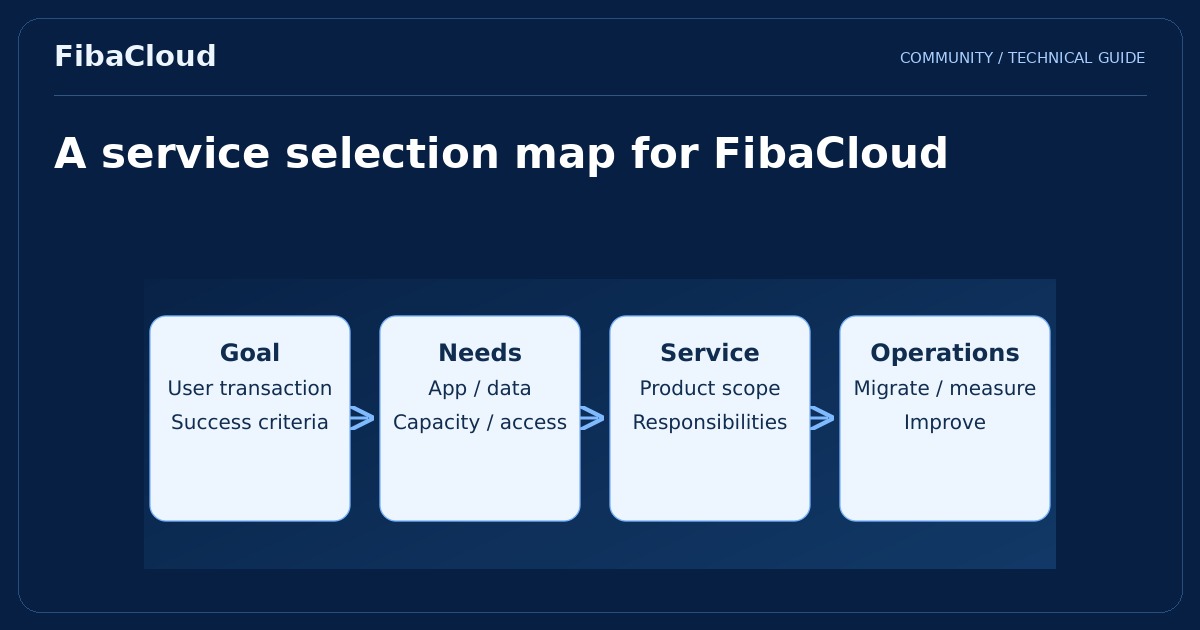
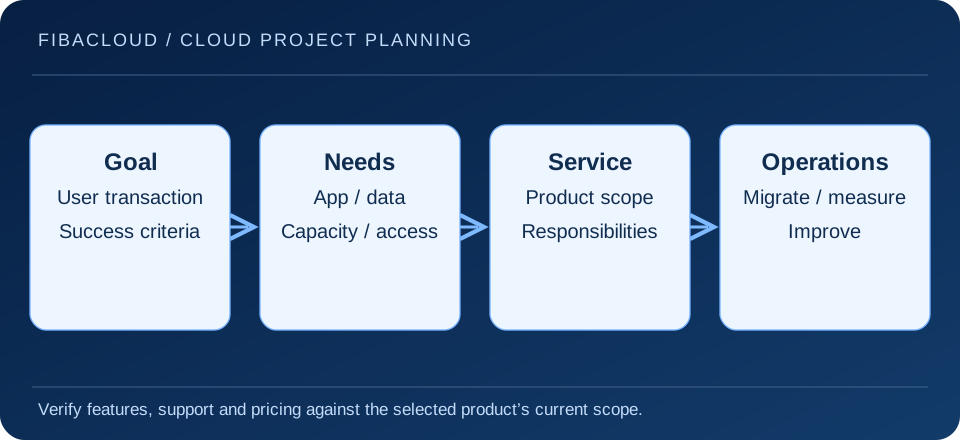
When planning a cloud project with FibaCloud, the first decision is what the application must help its customers accomplish reliably. A developer team may prioritize repeatable releases, while a small business may focus on orders and daily operations. Service selection turns those goals into resource, data and operating requirements.
Enlarge illustration →
Describe needs through the application
Consider an order management application as an example. Its web interface, database, product images and payment or accounting connections have different requirements. User count alone is insufficient: busy-period transactions, data growth and external dependencies matter together.
Record the required operating system and runtime, who needs administrative access and which data is critical. Connecting technical decisions to business expectations exposes unnecessary resources and missing dependencies earlier in the project.
Build a useful resource profile
Derive CPU, memory, storage and networking needs from application behavior. Sustained processing, periodic reports and file transfer create different patterns. Use existing measurements as a baseline or prepare a small pilot with representative data. Choosing the largest plan does not automatically resolve an architectural problem.
When comparing FibaCloud products, review allocation, storage and transfer conditions, location, licensing and resizing procedures together. A general cloud capability described in an article should not be assumed to be included in every product. Keep the selected plan’s current technical and commercial scope with the decision record.
Assign operating work early
Give application deployment, operating system updates, access rules, monitoring and backups explicit owners. The boundary between provider-operated infrastructure and customer-operated applications depends on the service. The presence of support does not mean that every software task becomes the provider’s responsibility.
In a small team, one person may perform several roles. Recovery knowledge and access should still not exist only on that person’s device. Prepare operating notes, suitable secret management and current contact information that authorized colleagues can use when needed.
Make the migration plan concrete
- Identify the data, its volume and its consistency requirements.
- Create a backup and verify restoration in a separate environment.
- Test user transactions and external connections in a trial deployment.
- Plan final synchronization, traffic cutover and the rollback decision.
- Set the observation period and identify who accepts the result.
For a database move, copying files may not be enough. Application versions, character sets, connection settings and scheduled jobs also need attention. Retiring the old environment should depend on acceptance criteria and retention requirements, not simply on seeing a new login page.
Measure success rather than assuming it
Use goals connected to the application’s work: critical transaction duration, error rate, successful restoration and total monthly operating cost. Give each goal a baseline and a review interval. Use comparable before-and-after evidence to assess savings or growth, accounting for changes in scope.
After the initial move, review unused resources, access and capacity trends. This turns service selection into an ongoing operating decision rather than a one-time price comparison. It also provides a clear reason for future changes as the application and team evolve.
Keep a short decision record explaining why the current configuration was chosen and which assumptions remain uncertain. When a workload changes, the team can then revisit the relevant assumption instead of rebuilding the entire evaluation from memory.
Frequently asked questions
- How should I choose an initial FibaCloud plan?
-
Start with application requirements, measured capacity needs and the team’s operating ability. Review the current product scope and confirm uncertain conditions before selection.
- Does cloud migration guarantee success or savings?
-
No. Outcomes depend on design, usage, service scope and operations. Set measurable goals that can be compared with a baseline.
Your next step
Compare FibaCloud products with your requirements. Complete the technical and operating decisions using the cloud computing overview and security guide.