Updated:
Cloud infrastructure can support an online store’s storefront, catalogue, orders and supporting services. Its value depends on how those parts work together. A fast product page is useful, but customers also need accurate stock, a reliable payment result and clear delivery information. Design the complete transaction before sizing the individual servers.
Enlarge illustration →
Separate public content from customer-specific state
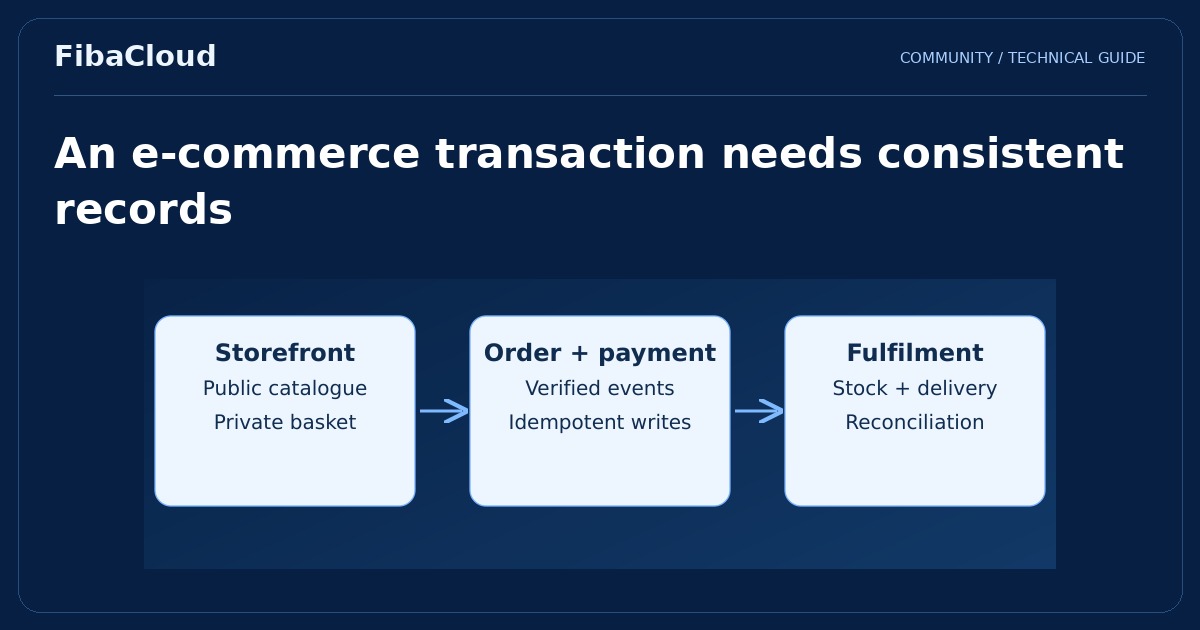
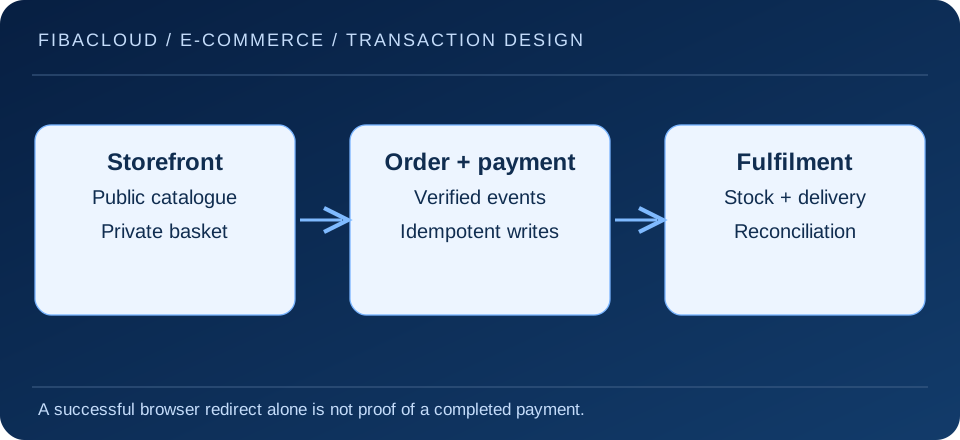
Product images and public catalogue content have different caching rules from baskets, account pages and checkout. Cache shared content where appropriate, while keeping private or personalised responses out of shared caches. Verify both the content and the headers used to control reuse.
Keep persistent uploads and order data separate from replaceable application releases. A deployment should not overwrite the files or records the business relies on. Define how each component is backed up and restored.
Make payment and order events consistent
A browser returning to a success page is not sufficient proof that a payment completed. Follow the payment provider’s documented verification process, validate signed notifications and reconcile the result with the server-side order record.
Notifications can arrive more than once or in a different order. Use stable transaction identifiers and idempotent handling so repeated events do not create duplicate orders, captures or fulfilment requests. Keep secrets out of source code and customer-visible logs.
Size the flow, not just the home page
| Component | Useful signal | Failure to consider |
|---|---|---|
| Storefront | Page and asset response time | Slow mobile experience |
| Catalogue | Query latency and cache behaviour | Stale price or stock |
| Checkout | Completed transactions and errors | Repeated or incomplete orders |
| Background work | Queue age and retry count | Delayed fulfilment or email |
A campaign may create bursts across several of these components. Load-test a representative path without sending test orders to real payment or fulfilment systems. Confirm the documented limits of external integrations.
Keep security responsibilities visible
Use least-privilege access for staff and service identities, protect administrative entry points and maintain dependencies. Payment outsourcing can reduce the card-data scope, but does not automatically remove all merchant responsibilities. Review the applicable PCI DSS scope with the parties responsible for the payment integration.
Customer information also needs a defined purpose, retention policy and access model. Do not collect card or identity data simply because a form could store it. A cloud service agreement should make infrastructure and application responsibilities clear.
Plan recovery in business terms
A technically restored database is only one part of recovery. Check whether order, payment, inventory and fulfilment records agree after an incident. Define the acceptable data-loss window and the target recovery time, then test the full service.
Compare the complete monthly cost: instances, storage, transfer, backups, licences and operation. Cloud capacity does not guarantee higher conversion or lower costs; those outcomes require measurement across the storefront and business process.
Frequently asked questions
- Will adding servers solve every checkout problem?
-
No. Database contention, payment limits, application logic and unreliable integrations can remain bottlenecks. Locate the cause before increasing capacity.
- Can an online store cache every page?
-
No. Public assets and catalogue content may be cacheable, while baskets, account pages and payment responses require careful privacy and freshness rules.
Your next step
Compare the FibaCloud product range with your storefront, order and recovery requirements, then model supported product costs in the calculator.