Updated:
IaaS, PaaS and SaaS help describe which layers of a cloud service the provider operates. The distinction is not simply a server type or price. It changes the software your team manages, the control it retains and the day-to-day responsibilities it accepts. Choosing a model means finding a suitable operational boundary for the application and the team.
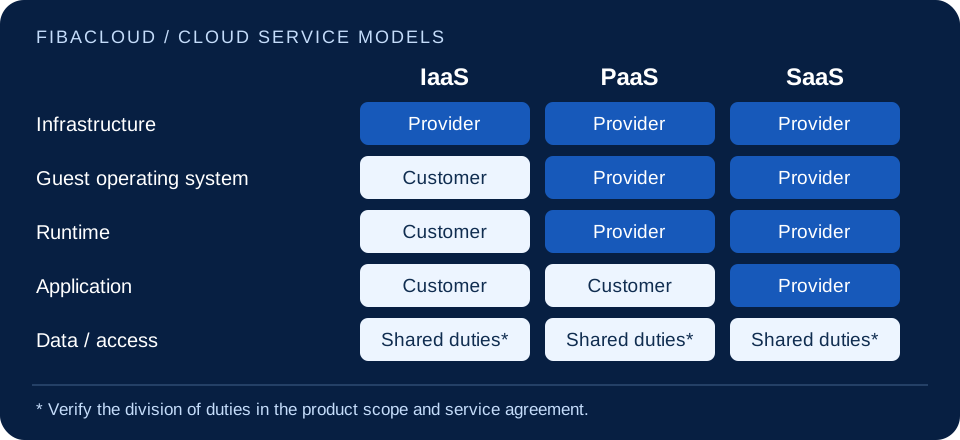
Enlarge illustration →
IaaS: control over infrastructure resources
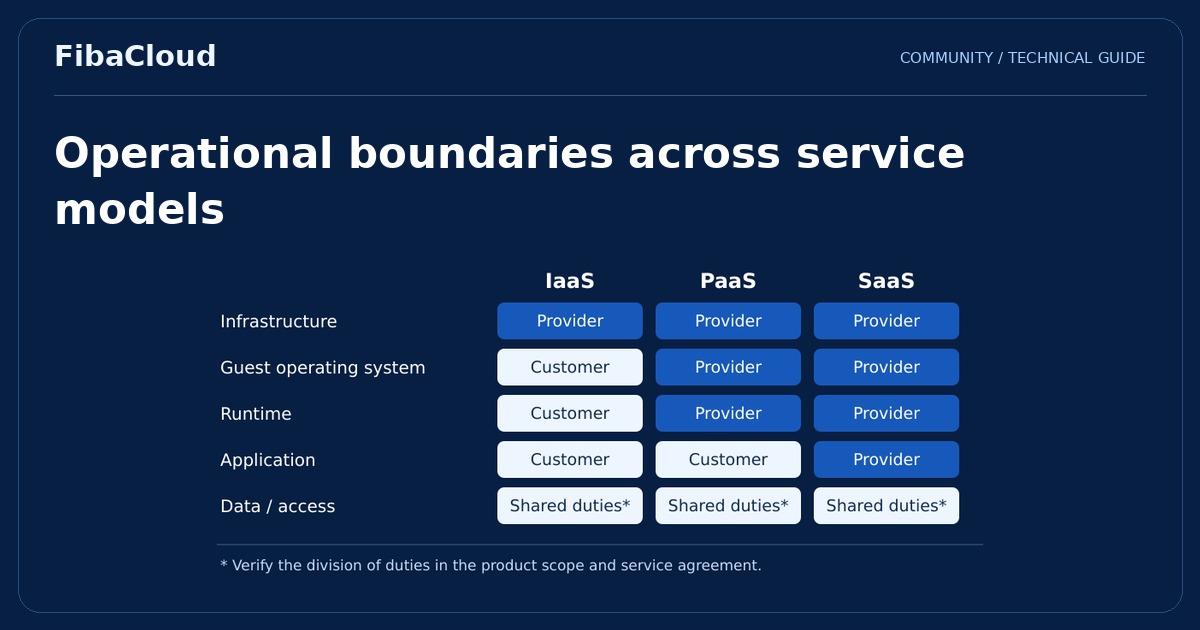
Infrastructure as a Service provides resources such as processing, memory, storage and networking. Virtual servers are a common example. The customer typically manages the guest operating system, installed software and application, while the provider operates the physical infrastructure and the virtualization layers specified by the service.
This can suit custom operating system or software requirements. It can also leave patching, access management, monitoring and application recovery with the customer. An additional managed service may change that scope. Renting a server and delegating its operation are different arrangements; check the actual responsibilities.
PaaS: a managed application environment
Platform as a Service offers an environment into which developers deploy an application. The provider may operate layers such as the operating system and runtime. The team still has responsibilities for application code, dependencies, data use and the configuration it controls.
PaaS can reduce operational work, but supported languages, versions, deployment patterns and networking choices remain bounded by the platform. An application needing a specialized system component may not have the same flexibility. Evaluate supported-version lifecycles and a practical way to move the application before committing to the platform.
SaaS: using an operated application
Software as a Service gives customers access to an application operated by the provider. Email, collaboration and business-management software can follow this model. Customers do not directly operate the underlying system, but still make decisions about user accounts, permissions, data entry and appropriate use.
Provider operation does not eliminate every data responsibility. Evaluate export capabilities, deletion, retention and access records. An account with excessive privileges can affect the business regardless of which service model is used.
Map the security boundary explicitly
The models are useful guides, but technical scope and contractual terms determine the details. Networking, backups, encryption keys and incident handling can be shared differently across products. A provider-supplied control may still require the customer to enable it or configure it correctly.
Data classification, account management and access reviews matter in every model. A service label alone does not establish regulatory suitability. Data location, subprocessors and legal requirements need their own assessment. Avoid treating a model name as a certification or a guarantee of a particular security outcome.
Use practical selection questions
- Can the team operate the required system and platform layers?
- Does the application need a specialized driver, runtime or network behavior?
- Must data or the application move to another environment later?
- Are recovery, monitoring and incident responsibilities clearly assigned?
- How do usage, storage, traffic and additional services affect total cost?
Different models can coexist in one organization. A team may operate application servers while using SaaS for collaboration. Evaluate each workload instead of forcing every requirement into a single label. Maximum control is not automatically the best fit for every team, and maximum delegation is not appropriate for every application.
Before a wider commitment, validate deployment, access, monitoring and data export in a small trial. Seeing the daily operating process alongside technical compatibility helps reveal responsibilities that a feature list may not make obvious. Record the outcome and keep the service scope available to the people who will actually operate and support the system.
Frequently asked questions
- Does PaaS or SaaS transfer all security responsibility to the provider?
-
No. Accounts, data use and customer-controlled settings remain important. Confirm the specific allocation of responsibilities for the product.
- Do all products from one cloud provider use the same model?
-
Not necessarily. A provider can offer different management levels. Evaluate each product’s technical and contractual scope.
Your next step
When exploring FibaCloud products, identify both the resource and the management level you need. Clarify any remaining operating responsibilities with the team before choosing a service.