
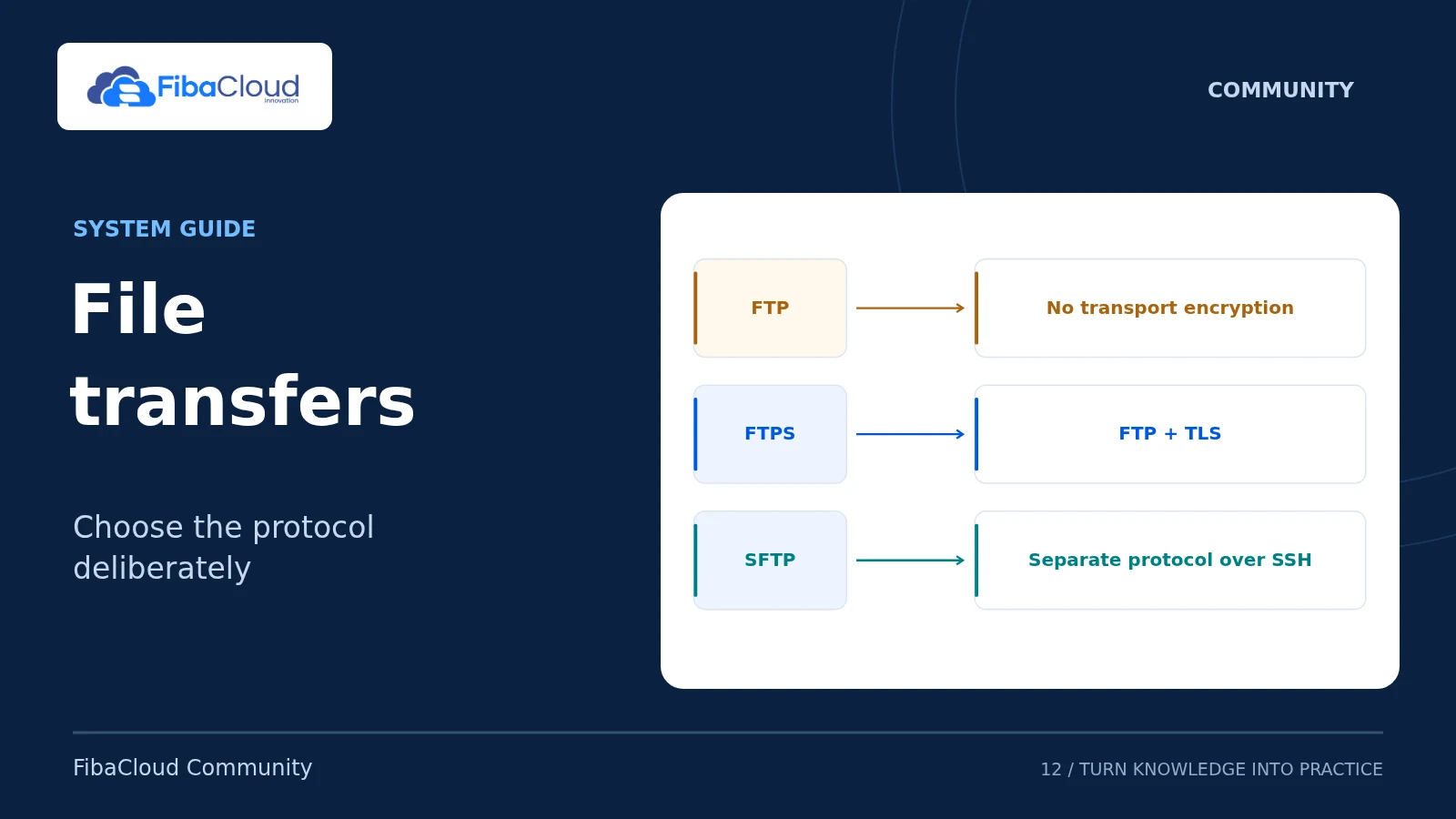
Protocol choice matters when transferring files: standard FTP does not encrypt passwords or file data. Use SFTP or FTPS with mandatory TLS, depending on what your server supports. SFTP is a separate protocol carried over SSH; FTPS adds TLS protection to FTP.
Prepare the account and connection details
This guide covers client uploads and downloads using an existing SFTP or FTPS account you are authorized to use. It does not install a server or change general access policies. A newly created cloud server does not necessarily include an FTP service or control-panel account.
Obtain the protocol, hostname, port, username, permitted destination directory and authentication method from the administrator. For SFTP, independently verify the SSH host fingerprint. For FTPS, verify the expected hostname and trusted certificate. Use a task-specific account limited to the required directory; file transfer should not require root access.
Back up existing site files before replacing them. Start with a small file in an empty test directory. Check quotas, available space and file-size limits.
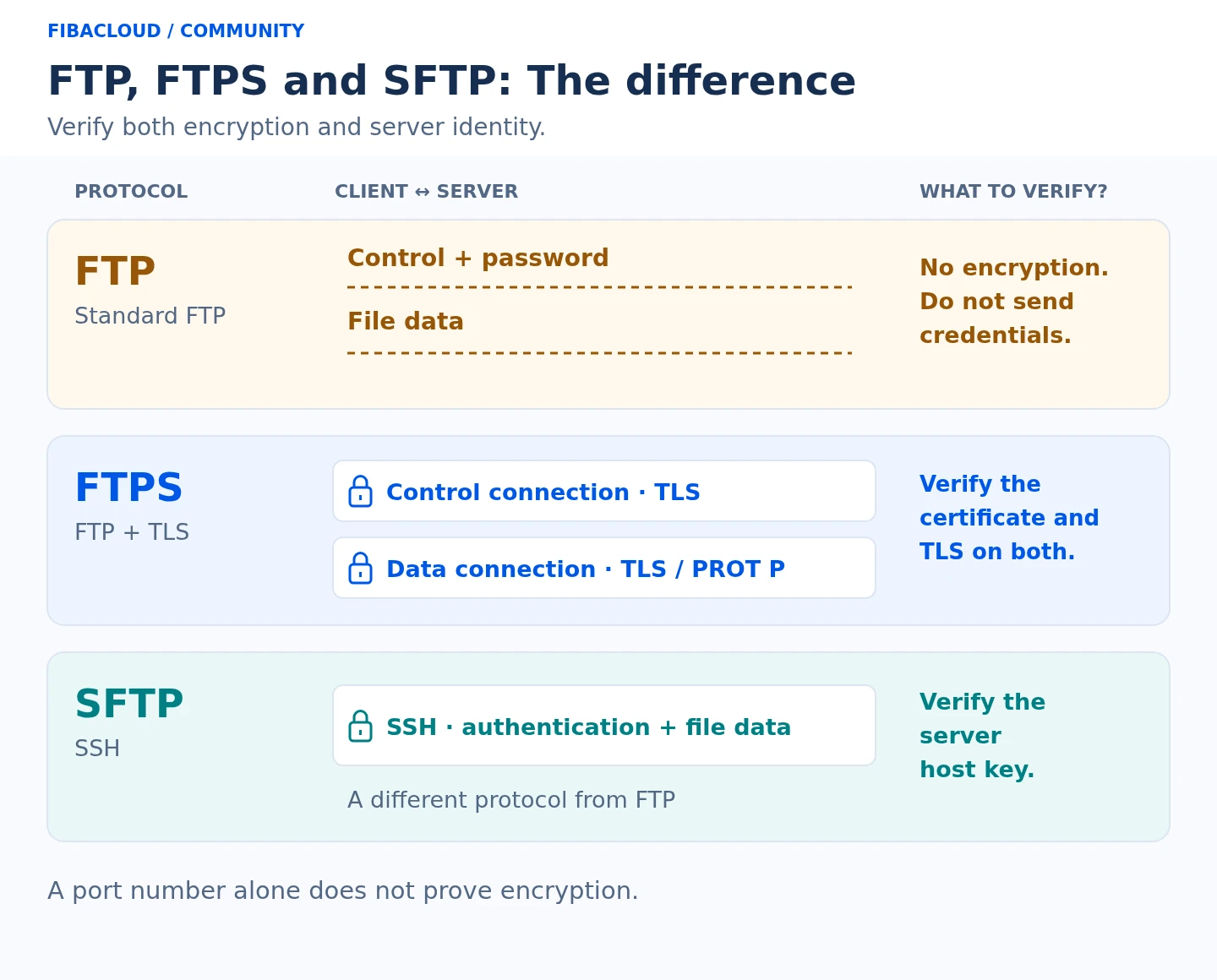
Text description of the illustration
- Standard FTP sends credentials and files in cleartext; do not send credentials.
- Require TLS for the FTPS control connection and private protection (PROT P) for data.
- For SFTP, compare the SSH host fingerprint through a trusted channel.
- Verify the server identity, account and destination before transfer; a port alone does not prove security.
Compare FTP, FTPS and SFTP
| Protocol | Transport protection | Server identity | Key requirement |
|---|---|---|---|
| FTP | None in standard FTP | No TLS/SSH verification | Do not send passwords or private data. |
| FTPS | TLS on control and data connections | Certificate and hostname | Reject unencrypted fallback and protect the data channel too. |
| SFTP | SSH transport | SSH host key | Compare the first fingerprint through a trusted channel. |
SFTP usually uses the SSH port. Explicit FTPS commonly begins on the FTP control port and opens additional data connections. A port number alone does not prove encryption. Use the protocol and port supplied by the administrator.
Connect with SFTP in FileZilla
Obtain FileZilla Client from its official source. Open File → Site Manager and create a new entry:
- Select SFTP — SSH File Transfer Protocol.
- Enter the verified hostname, port and assigned username.
- Select a password or key method accepted by the server. A private key stays on your device.
- Compare the first host key’s type and fingerprint with the trusted console/administrator record. Do not accept a mismatch.
- Confirm that the remote directory on the right is the intended destination, not another site with a similar name.
A certificate warning and an SSH host-key warning are different checks. Expecting a TLS certificate in SFTP or an SSH key in FTPS confuses the protocols.
If the server uses FTPS
Select FTP — File Transfer Protocol in Site Manager and set encryption to Require explicit FTP over TLS, after confirming server support. If the server requires a different FTPS mode, follow the administrator’s mode-specific port and client instructions.
Verify the certificate hostname, validity period and trusted chain. Do not bypass an unknown certificate or hostname mismatch with a permanent exception. Encrypting the control connection is not enough: file data needs TLS as well. In FTPS, PROT P requests private protection for the data connection. Check the client log for a protected data connection.
If directory listing works but transfers stall, have the administrator inspect the configured passive data-port range and network rules. Do not disable TLS or open every firewall port as a workaround.
Verify a small test transfer
The OpenSSH sftp example below assumes that the host key has already been verified. In an empty local working directory, ensure that the filename is unused and create a test file:
Leave a Reply